Surfing skills and progression

IASE 1-7

From your first whitewater ride to confident wave-face control and your own surfing style.

IASE 1

First rides with guidance

Prepare your board, stand up in gentle whitewater and finish the ride safely with instructor guidance.

Starting point

No surfing experience required. An instructor first checks your water confidence and the conditions.

Core techniques

  • Equipment: identify the nose, tail, rails and fins; choose a suitable board and check the leash before entering.
  • Paddling: find the board's balance point, keep a steady body position and practise alternating strokes.
  • Pop-up and stance: place your feet, bend your knees and look ahead without losing balance.

Ocean awareness and safety

  • Identify the practice zone, entry and exit routes, local warnings and the instructor's signals.
  • Keep space from other people and boards; practise a controlled finish, a safe fall and protecting your head.

Practice and review

Link preparation, an assisted whitewater take-off, a stable ride and a controlled exit. Review one specific balance or timing issue.
IASE 2

Independent whitewater surfing

Choose and catch suitable whitewater, stand up and maintain a stable ride without an instructor pushing the board.

Starting point

You can stand and balance in guided whitewater rides and finish safely.

Core techniques

  • Wave timing: select a suitable whitewater wave, align the board and accelerate before it reaches you.
  • Independent take-off: coordinate paddling and the pop-up while keeping a functional stance.
  • Basic control: adjust weight and gaze to keep the board moving steadily and begin gentle direction changes.

Ocean awareness and safety

  • Respect the riding lane, wait your turn and keep clear of other surfers' boards and leashes.
  • Stay inside the agreed practice area and recognise when fatigue, currents or changing conditions require a break.

Practice and review

Repeat the full whitewater sequence independently. Separate missed waves, unstable pop-ups and balance losses to choose the next drill.

IASE 3

Independent green-wave surfing

Catch and ride suitable small, unbroken waves independently, with consistent take-offs and safe exits.

Starting point

Independent whitewater catching and stable pop-ups; an instructor checks readiness for the outside surf zone.

Core techniques

  • Positioning: identify the peak and shoulder, adjust the waiting position and time the paddle into an unbroken wave.
  • Green-wave take-off: match the wave's acceleration, stand at the right moment and establish the first riding line.
  • Initial wave-face control: use gaze, stance and gentle rail pressure to start travelling along an open face.

Ocean awareness and safety

  • Understand priority and no drop-ins; choose a paddling route that avoids another surfer's riding line.
  • Practise board-appropriate paddle-out techniques with an instructor and identify a safe return route.

Practice and review

Complete the cycle of positioning, catching, riding and exiting in suitable conditions. Review wave choice separately from take-off technique.

IASE 4

Wave-face lines and speed

Extend your rides by choosing a line across the wave face and adjusting speed with control.

Starting point

You can independently catch suitable green waves, stand consistently and exit with control.

Core techniques

  • Frontside and backside: hold an angled line and explore higher and lower paths on the wave face.
  • Speed adjustment: coordinate body compression, extension and weight distribution with the section ahead.
  • Rail control: make deliberate direction changes and introduce a bottom turn suited to the wave and board.

Ocean awareness and safety

  • Read the peak, shoulder and closing sections; notice how wind, tide and currents affect your position.
  • Choose waves with an open route and an exit you can manage, rather than chasing every available wave.

Practice and review

Review your line, stance and speed on video. Identify where you lose momentum and practise returning to the wave's useful energy.

IASE 5

Connected turns and board control

Connect directional manoeuvres while maintaining balance, speed and control near the wave's power zone.

Starting point

Stable frontside and backside wave-face rides, with purposeful speed and direction changes.

Core techniques

  • Bottom-to-top transitions: use a planned bottom turn to set the direction and timing of the next turn.
  • Cutback foundations: choose the turn point and arc to return towards the pocket without losing control.
  • Manoeuvre selection: connect turns that suit the section, rather than repeating the same movement on every wave.

Ocean awareness and safety

  • Match your board and manoeuvres to the wave's shape and power; a smaller board is not automatically a progression.
  • Check the next section and nearby surfers before committing; retain a controlled exit option.

Practice and review

Work on a short sequence of linked turns in both directions. Compare intended lines with actual board movement and the speed carried between turns.

IASE 6

Advanced combinations and specialisation

Link manoeuvres with flow and develop board-specific skills in a chosen longboard or shortboard pathway.

Starting point

Consistent linked turns, deliberate rail use and reliable control across suitable wave sections.

Core techniques

  • Refined cutbacks: adjust timing, rail engagement and turn radius to reconnect smoothly with the wave's energy.
  • Longboard pathway: develop cross-stepping, trim and suitable noseriding exercises, including a controlled return.
  • Shortboard pathway: develop stronger bottom and top turns, projection and fluid transitions between manoeuvres.

Ocean awareness and safety

  • Choose conditions appropriate to your discipline and current ability; account for local access and hazards.
  • Plan around currents, crowding and fatigue, and know when to change the session or stop.

Practice and review

Use video to review speed, flow, control and completion. Build a personal training plan for your chosen board; longboard and shortboard tasks are not interchangeable.

IASE 7

Advanced performance and individual style

Deliver consistent, purposeful high-level surfing and develop a personal style or competition-focused performance.

Starting point

Strong Level 6 skills in the chosen discipline, with appropriate conditioning and specialist coaching assessment.

Core techniques

  • Performance choices: combine timing, variety and execution quality with a deliberate reading of each wave.
  • Discipline-specific expression: refine longboard footwork and nose control or advanced shortboard combinations.
  • Competition preparation: practise wave selection, heat timing and priority decisions under the applicable event rules.

Ocean awareness and safety

  • Barrels and aerials are specialist options only when ability, conditions and coaching support are appropriate.
  • Set personal limits and a support plan. Big-wave surfing is a separate specialist discipline, not a universal level requirement.

Practice and review

Review consistency, decision-making and execution across multiple sessions. Set individual technical, physical and competition goals with a coach.

Plan your next step

Choose your starting level by current ability, not by lessons attended. Confirm lesson plans, fees and assessment arrangements with your school.

Global surf spots

This is a learning guide, not a revised certification rubric. Training must match the learner and conditions. Course attendance does not by itself mean assessment passed or a certificate earned.

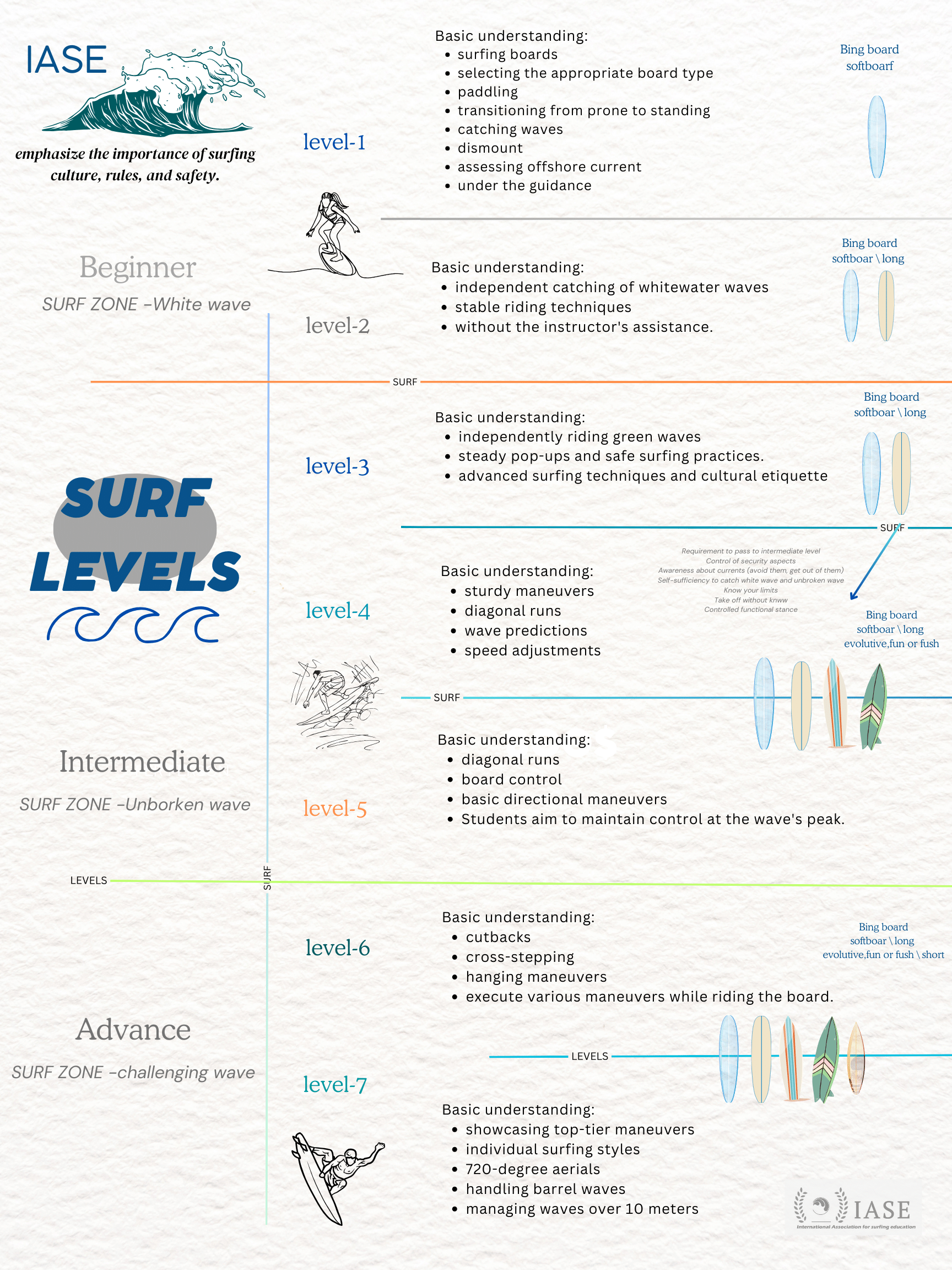
IASE level overviewIASE level overview

Advanced examples in the original overview are not universal pass requirements. Specialist training and formal assessment must be confirmed separately.